
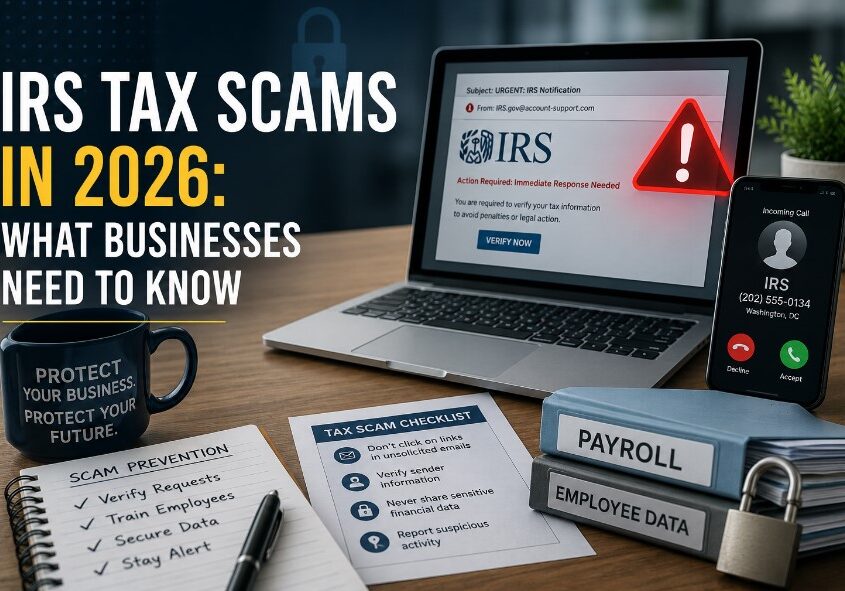
IRS tax scams targeting businesses are increasing in 2026, with cybercriminals using more advanced tactics to steal sensitive data and money. Small businesses are especially vulnerable due to limited internal controls and high reliance on email communication.
Understanding the most common tax scams and how to prevent them can help protect your business from financial loss and identity theft.
1. Phishing Emails Posing as the IRS or Financial Institutions
Phishing remains one of the most common IRS scams targeting businesses. Attackers send emails that appear to come from the IRS, banks, or accounting providers to trick recipients into revealing sensitive information.
How to identify phishing IRS scams:
- Unexpected emails about taxes, audits, or refunds
- Suspicious links or file attachments
- Misspelled or unusual email domains
How to prevent phishing attacks:
- Avoid clicking links in unsolicited tax emails
- Verify requests directly with your accountant or financial institution
- Train employees on phishing awareness
Key fact: The IRS does not initiate contact through email.
2. Fake Charities and Donation Tax Scams
Fake charity scams increase during tax season and times of crisis. Scammers create organizations that look legitimate to collect donations that are not tax-deductible.
Warning signs of fake charities:
- Urgent or emotional donation requests
- Names that closely resemble real charities
- No verifiable tax-exempt status
How to avoid charity tax scams:
- Verify organizations using IRS tax-exempt databases
- Request the charity’s EIN
- Donate only through official websites
3. IRS Impersonation Phone Scams
IRS impersonation scams involve criminals calling business owners and claiming immediate tax payment is required. These scams rely on fear and urgency to force quick decisions.
Common tactics used in IRS phone scams:
- Threats of penalties, audits, or arrest
- Requests for payment via gift cards, wire transfers, or cryptocurrency
- High-pressure language
How to prevent IRS phone scams:
- Never provide financial information over the phone
- Hang up and verify through official IRS channels
- Educate staff about scam call warning signs
Important: The IRS does not demand immediate payment or threaten arrest by phone.
4. W-2 and Payroll Data Theft Scams
W-2 scams target HR and payroll departments. Attackers impersonate executives and request employee tax forms, leading to identity theft and fraud.
How W-2 scams work:
- Emails appear to come from company leadership
- Requests are urgent and involve sensitive employee data
- Attackers use social engineering tactics
How to prevent W-2 scams:
- Require multi-step verification for data requests
- Restrict access to payroll and tax documents
- Train employees to confirm requests through a secondary channel
5. Fraudulent Tax Preparers and Filing Scams
Some tax preparers engage in fraudulent practices, putting businesses at risk of audits, penalties, or stolen refunds.
Signs of a fraudulent tax preparer:
- Promises of unusually large refunds
- Fees based on refund amounts
- Refusal to sign tax returns
How to choose a trusted tax professional:
- Verify credentials and licensing
- Check reviews and references
- Ensure the preparer includes their PTIN on your return
How to Prevent IRS Tax Scams in Your Business
To reduce risk, businesses should implement strong internal controls and security practices:
- Conduct regular employee training on scam awareness
- Use email security and phishing filters
- Establish verification procedures for financial and data requests
- Limit access to sensitive tax and payroll information
How to Respond to a Tax Scam
If your business is targeted by an IRS scam:
- Do not respond or engage
- Document all communications
- Report the incident to the IRS and relevant authorities
- Notify employees if sensitive data is involved
- Review and strengthen internal security policies
Conclusion
IRS tax scams in 2026 are becoming more advanced and harder to detect. Businesses that rely on awareness, verification processes, and strong internal controls are better positioned to avoid financial loss and data breaches.
Staying proactive is the most effective way to protect your business from tax fraud.


